“Willie Birch: Transforming Identities”
The journey began when a precocious child talent was recognized by “my junior high teacher, Mrs. Maxine Daniels, who took her father’s insurance money and created an art school for talented kids at the YMCA.

The journey began when a precocious child talent was recognized by “my junior high teacher, Mrs. Maxine Daniels, who took her father’s insurance money and created an art school for talented kids at the YMCA.
Whitfield Lovell is an inveterate scavenger and collector. He seems to be a born taxonomist, a close examiner and evaluator of material culture. In this respect he has always been comfortable with the play of time, both private and historical.
All art critics have some Ebenezer Scrooge in them. We wouldn’t mind at all seeing struggling artists working in their chilly, dark studios on Christmas Eve. Why should they misspend their time in the bosoms of their families, when there are paintings to be painted, sculptures to be sculpted? Art knows no holidays. As for critical generosity, bah, humbug.
All art critics have some Ebenezer Scrooge in them. We wouldn’t mind at all seeing struggling artists working in their chilly, dark studios on Christmas Eve.
Willie Birch is a native son of the Crescent City whose firebrand political art has made him a player on the national and even international art scenes. Over the past two years, though, his work has changed so much that you could easily miss the political messages.
by Jessie Morgan, Tulane University Gene Koss artwork is unusual, not only because of its size (large), its weight (eight tons) or even its subject (farm machinery), but also it’s…
The exhaustive, 186-piece retrospective of George Dureau’s photography at the Contemporary Arts Center may very well offend you. To begin with, the 69-year-old artist’s principle subject is the nude male, with no detail left unexposed.
Simon Gunning has painted natural landscapes and he has painted urban landscapes. In his “River Series” he does both, simultaneously. The images…are each a study in startling, if at times eerie, incongruity.
Ascend into the coolly seductive, eerily beautiful night sky of New Orleans artist Mary Jane Parker at the 1708 Gallery.
You may never want to come down to Earth.
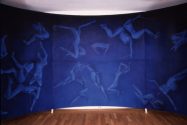
Ascend into the coolly seductive, eerily beautiful night sky of New Orleans artist Mary Jane Parker at the 1708 Gallery.
You may never want to come down to Earth.
Parker painted her site-specific “Skywatching” in her New Orleans studio in oil on four flexible plywood panels. The panels were assembled to form a semicircular floor-to-ceiling cyclorama in 1708’s back gallery.