Gallery News

“A multifaceted art exhibit meriting the ‘visions’ in its name,” Crosscut.com

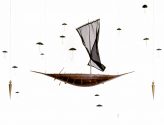
Lesley Dill’s Poetic Visions: from Shimmer to Sister Gertrude Morgan focuses on two bodies of work by the versatile artist: one is metallic sculpture and the other is an installation inspired by the late folk artist, preacher, and New Orleans phenomenon Sister Gertrude Morgan. This exhibit is what you dream those dusty Smithsonian displays could be. It is history gone wild; a show of visual might that makes one feel like a child entering Disneyland.

Read More

“Soul Man,” Journal North

All artists build imaginary spaces. James Drake is fully cognizant of the human tendency to project subjective history and meanings into the spaces he opens and constructs. Even before the visitor reaches the formal entry of his current exhibition at the New Mexico Museum of Art, the artist has placed three functional steel sculptures that announce his personal point of view. These include two benches and a graceful child’s table stacked with books of art and literature that are meaningful to him. There are monographs on Goya, Daumier, Rubens, the Mexican muralists, the novel “Blood Meridian” by Cormac McCarthy, two books of poetry by Jimmy Santiago Baca, including “Que Linda la Brisa” (2001) with photographs by Drake, and the 2008 University of Texas survey of the artist’s 35-year career.

Read More

James Drake at the New Mexico Museum of Art, Santa Fe

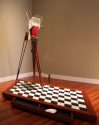
Throughout his career, James Drake has examined the theme of humanity in all of its triumphs, failures, and follies—including violence and war; love and desire; greed and gluttony; and the realities of life along the U.S.-Mexico border. The exhibition James Drake: Salon of a Thousand Souls includes sculptures and works on paper by the Santa Fe-based artist dating from the 1980s to the present day. Among the dozen works to be shown are a never-before-exhibited 21-foot red pastel drawing and a wall drawing done in the museum galleries specifically for this exhibition.

Read More

“Lin Emery: Unique Forms of Continuity in Space and Time,” Sculpture Magazine

Originality has an inside and an outside. Understanding the nature of originality in sculpture requires an understanding of both—of the inside, what it is in the sculptor’s life that created her artistic personality, and the outside, what sets her work apart from that of other artists of similar inclination. In Lin Emery’s case, there is a strong connection between these two sides of originality: the personal dynamic of her artistic evolution explains her place in the history of kinetic sculpture. There is a consistent element of autonomous discovery in Emery’s artistic life, as well as a highly personal mix of philosophical and artistic influences. In some ways, her work constitutes a logical part of the tradition of kinetic sculpture that descends from Constructivism. But her sensitivity to natural forms and modes of movement sets her work apart and enriches that tradition.

Read More