Press & Media
“Common Ground,” New Orleans Art Review – Fall/Winter 2011-2012
Review: Luis Cruz Azaceta, Gambit
Change happens. That’s not news, but lately the pace seems to be picking up in often perplexing ways. Such is the proposition that propels Luis Cruz Azaceta in his Shifting States expo at Arthur Roger Gallery.
Dawn DeDeaux’s “Goddess Fortuna and Her Dunces In an Effort to Make Sense Of It All” featured in Artillery Magazine
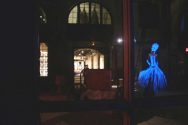
Open only at night, DeDeaux’s installation riffs on Toole’s evocation of fate and furies. The artist uses the three-story mansion to great effect. Off each story is a balcony, behind which are French doors and windows. Using various staging setups, including mannequins costumed with dunce hats that look weirdly like figures from the Inquisition, and a room full of masks and odd artifacts, she sets up a fun-house tableau on each floor. There are rooms you can enter and rooms that you view from the center of the courtyard, which boasts a wagon with a fountain that has distinct masturbatory connotations, consistent with the Reilly character. The rooms have video projections or staged lighting, which makes a dramatic impact. Looking up from the grounds of the courtyard, you can see ethereal, spinning videos. In a large downstairs room is a dance video, if one can call it that. DeDeaux cast the contemporary diva of New Orleans bounce music, Katey Red, to play the role of Goddess Fortuna, accompanied by two backup dancers as “the Wheelettes”—to spin the wheels of our fate. The energetic figures in the video have an uncanny optical effect of appearing disembodied in the outdoor courtyard through a device of reflection. I watched entranced through the windows of the room at the courtyard; it was truly disturbing, and inspiring. Worked from its literary source, DeDeaux’s zany, smart and wildly imaginative installation goes far beyond illustration to become an atmosphere that is indeed inhabited by the Goddess Fortuna.
“Update: Azaceta in New Orleans, U.S. Photographers Snap Cuba, Havana Charrette Coming Soon—and More,” Cuban Art News
From CubanArtNews.org, January 9, 2012 Luis Cruz Azaceta in New Orleans. From collapsing economies to the consequences of climate change, the instability of global affairs has been, for many of…
“A multifaceted art exhibit meriting the ‘visions’ in its name,” Crosscut.com
Lesley Dill’s Poetic Visions: from Shimmer to Sister Gertrude Morgan focuses on two bodies of work by the versatile artist: one is metallic sculpture and the other is an installation inspired by the late folk artist, preacher, and New Orleans phenomenon Sister Gertrude Morgan. This exhibit is what you dream those dusty Smithsonian displays could be. It is history gone wild; a show of visual might that makes one feel like a child entering Disneyland.
“James Drake: Salon of a Thousand Souls,” THE Magazine
HOW TO ADDRESS GREATNESS? I find it surprisingly difficult to write about an exhibition by an artist whom I greatly admire – James Drake, in this case, and his show of works from the 1980s through the present. Salon of a Thousand Souls was so intelligently presented by curator of contemporary art Laura Addison (with the artist’s input) that I fear anything I might add would appear as the slobbering gibber of a sycophant. I am reduced, therefore, to description, with the endorsement that you go see the exhibition, stat.
“Soul Man,” Journal North
All artists build imaginary spaces. James Drake is fully cognizant of the human tendency to project subjective history and meanings into the spaces he opens and constructs. Even before the visitor reaches the formal entry of his current exhibition at the New Mexico Museum of Art, the artist has placed three functional steel sculptures that announce his personal point of view. These include two benches and a graceful child’s table stacked with books of art and literature that are meaningful to him. There are monographs on Goya, Daumier, Rubens, the Mexican muralists, the novel “Blood Meridian” by Cormac McCarthy, two books of poetry by Jimmy Santiago Baca, including “Que Linda la Brisa” (2001) with photographs by Drake, and the 2008 University of Texas survey of the artist’s 35-year career.
“Mixed-Media Photographs and glass sculpture at Arthur Roger Gallery,” Gambit
In December, New Orleans is brimming with art events including Prospect.2, photo shows at PhotoNOLA’s array of gallery shows and the architecture expo DesCours, presented by the local chapter of the American Institute of Architects. It’s a bit much. Among the photography shows, Arthur Roger Gallery got a jump start with Ted Kincaid’s archaic looking land, sea and sky scenes resembling 19th century “wet-plate” photographs, a process prized for its poetic imperfections, but Kincaid’s work is mostly digital. Here the landscapes are dramatically otherworldly, as if some 19th century romantic artist like Alfred Bierstadt had suffered many darkroom mishaps but still got some occasionally inspired results.
“Lin Emery: Unique Forms of Continuity in Space and Time,” Sculpture Magazine
Originality has an inside and an outside. Understanding the nature of originality in sculpture requires an understanding of both—of the inside, what it is in the sculptor’s life that created her artistic personality, and the outside, what sets her work apart from that of other artists of similar inclination. In Lin Emery’s case, there is a strong connection between these two sides of originality: the personal dynamic of her artistic evolution explains her place in the history of kinetic sculpture. There is a consistent element of autonomous discovery in Emery’s artistic life, as well as a highly personal mix of philosophical and artistic influences. In some ways, her work constitutes a logical part of the tradition of kinetic sculpture that descends from Constructivism. But her sensitivity to natural forms and modes of movement sets her work apart and enriches that tradition.