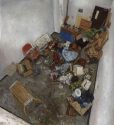
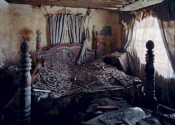
“New Orleans, Lost & Found”, Art in America
In a recent exhibition and book, Robert Polidori, known for making startling images of
architecture around the world, turns his camera on post-Katrina desolation.
In a recent exhibition and book, Robert Polidori, known for making startling images of
architecture around the world, turns his camera on post-Katrina desolation.
For years, New Orleans painter Jim Richard has articulated an acidic social commentary through unpeopled interiors of the showy sort featured in domicile magazines. Many of his paintings employ an icy, synthetic palette to depict settings over-decorated with contrasting examples of historical and recent art. “These are the places,” one critic wrote, “where art goes to die.”
Nicole Charbonet’s current body of work, entitled, The Truth about God, deals with subjects such as the temporality of the material world and the power of nature. Charbonnet portrays these thoughts in a series of canvases, all done in mixed media and acrylic. Her works are at once alarming but offer a sense of calm in their soft, fresco like appearance, reminiscent of the colors of Pompeii, muted almost to a whisper with the patina of time.
THE ANCIENT ARCHETYPES of various European, Caribbean, Native American, and African cultures weave together this timeless exhibition of totemic carvings by John Geldersma. With simple wood and paint, the colors of which seem almost inspired by fire, he reaches into an understanding of humanity, the history of its culture, unmistakably modem because of its far reaching universality.
NOW, ASK YOURSELF, honestly, what kind of art would you imagine you would find when you read that an exhibition involving Waters and Flood was opening at the Arthur Roger Gallery this month?
With the sympathetic understanding of the insider and the objectivity of the ethnographer, artist Willie Birch furthers the social documentary tradition of photographers Helen Levitt, Roy de Carava, and Robert Frank.
Art, by its very nature, is worth more than the ingredients that give it shape. A clay pot is worth more than the lump of clay from which it was formed, a painting more than the paint and canvas. Similarly, the bronze sculptures in John Scott’s eastern New Orleans studio were worth more than the bronze itself.
The thieves may not have known what exactly they stumbled onto when they climbed through a broken window of a nondescript warehouse in eastern New Orleans.
Allison Stewart is yet another abstract romantic, but her temperament is distinctive. Although she is conceptually allied with Marden and Dunbar— complete with an overmastering theme — she does not share their restraints.
Douglas Bourgeois, both magician and mechanic, deconstructs and reconfigures reality as a hermetic and skewed detail-packed world. He is an artist of these times, this country, and, specifically, New Orleans.