Press & Media

“Stephen Paul Day’s Blame it on Vegas – Collecting Meta-Modern,” a Short Essay by Amy Mackie
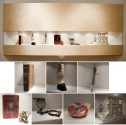
A zebra leg, a copy of Mein Kampf, slave shackles—discrete objects laden with meaning and chosen for their obvious aura—are precisely the kind of curiosities one might find in collections housed at institutions such as The Museum of Jurassic Technology, The Griot Museum of Black History, or the Mütter Museum. Contextualized alongside other anonymously created or found works, some humorous, some horrific, Blame It On Vegas – Collecting Meta Modern functions as a Wunderkammer, a collection that inspires infinite interpretations. The title is both a response to Robert Venturi’s controversial book Learning from Las Vegas and a rejection of postmodernism in favor of a new romanticism or what has come to be known as metamodernism. This slightly nebulous curatorial approach is, in a sense, a “metagesture,” where objects and ideas are abstracted and obscured. Oscillating between modernist vocabularies and postmodern strategies, but relying on neither, there is a rigor and a sense of purpose that unites this collection, though the precise meaning may not be, or may never be, fully realized.
Read More

“Art critic’s picks for Saturday’s Julia Street gallery openings,” The Times-Picayune

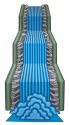
Smart, sure and silky smooth, Gordy’s acrylic canvases from the 1970s and 1980s remain a high water mark in New Orleans art. Gordy was one of those painter’s painter; his every work is a lesson in color choice, value modulation and economical design. After all these years, I imagined I’d seen all of Gordy’s mid-career works, but the shaped canvas waterfall featured on the gallery website was a revelation

Read More

“Homage to John Scott,” Art e-Walk

With John T. Scott’s preferred jazz tunes playing in the background, the Louisiana Art and Science Museum downtown Baton Rouge invites the visitor to look at the artist and his colleagues’ works during the exhibition Rhythm and Improvisation: John T. Scott and his Enduring Legacy.

Read More

“From the Walls Out: Whitfield Lovell at Hunter Museum of Art,” American Legacy

About ten years ago American Legacy featured an artist named Whitfield Lovell in an article titled “Whispers from the Walls.” The Bronx-born Lovell, whose three-dimensional tableaux—life-size charcoal portraits on pine board, punctuated with everyday (and not so everyday) objects found in flea markets and antique malls, tel the life stories of ancestors, family, and once anonymous individuals from the nineteenth and early twentieth centuries.

Read More

“Pattern Recognition: Stephanie Patton and Troy Dugas at Arthur Roger Gallery,” louisianaesthetic

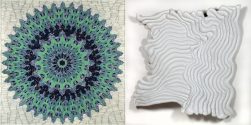
Currently at the Arthur Roger Gallery in New Orleans, two Lafayette, LA artists who bring pattern to the fore in their own works are exhibiting: Stephanie Patton and Troy Dugas. Within both bodies of work, the two artists begin with a simple premise, a minimum of materials, and a highly repetitive process. However, their finalized works speak to the complexity, beauty and meaning that can unfold from such humble and rudimentary origins.

Read More

“Surls, Wiener and Tobolowsky pieces to be on display for 2 years,” Tyler Paper

The “art world” might revolve around cities such as New York City and Paris, but a world-renowned Texas-born sculptor plans to stir interest in East Texas. James Surls, 69, a modernist sculptor, has shown his art in the Museum of Modern Art and the Guggenheim Museum in New York. He has pieces on display in museums around Texas, the nation and globe. Surls has made his name and enjoyed critical success spanning more than four decades. He isn’t interested in critics. Public interest in art interests him, he said.

Read More

“Review: Troy Dugas and Casey Ruble,” Gambit

In the art world, some people wonder if this is the worst or the best of times. Neither of the leading art capitals, New York and London, have produced any truly exciting new art or artists in ages, but the silver lining is that tedious trends like postmodernism no longer rule, and vital regional art scenes like New Orleans and Los Angeles have never been more highly regarded. This quiet revolution that transcends the prevailing “isms” is exemplified in Acadiana-based Troy Dugas’ large cut-paper collages.

Read More

“Review: New work by Monica Zeringue and Stephanie Patton,” Gambit

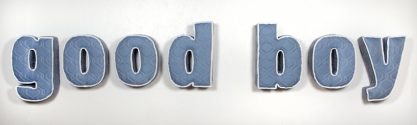
Stephanie Patton’s Private Practice show continues her exploration of psychic and physical healing in padded white vinyl wall hangings, fanciful soft sculptures that evoke the convolutions of the brain or even padded cells — or maybe what might have happened had a bedding company hired Salvador Dali as a designer.

Read More

“Review: Troy Dugas at Arthur Roger Gallery,” Pelican Bomb

Meant to instruct in the art of attentiveness, a mandala is a visual aid used in Hindu and Buddhist meditation. In classical form, the design contains four “gates” that guard a central circle. An honest rhetorical question then: do make-your-own-mandala websites and Urban Outfitters’ mandala bedspreads undermine the significance of this mystical emblem? This isn’t to scoff at the mandala’s new pop-Zen identity, but to witness the mandala moment while trends, and the technologies that are their silent backdrop, become increasingly antithetical to its symbolism and utility is bizarre.

Read More