Press & Media

“Review: Bruce Jr. Does the Parades and Sunrise,” Gambit
Another Hurricane Katrina anniversary came and went, and once again global news organizations struggled to find new angles on an increasingly old story. This time, the BBC memorialized America’s megastorm by posting a video interview with New Orleans artist Dan Tague, whose prints of dollar bills folded into catchy messages like “Live Free or Die,” or, more darkly, “Trust No One,” were an indirect result of Katrina. Tague survived the floodwaters in Mid-City, where he used a pirogue to help stranded neighbors, but later found himself feeling aimless after the forced exodus. With his studio under water, he began folding dollar bills to pass the time. He eventually turned them into prints, which found their way into major museum collections, and the rest is history. The BBC piece is not only a great survivor story, it also provides an interesting angle on the role money plays in American culture.
Read More

“With Watermark, Burtynsky and Baichwal finally go with the flow,” The Globe and Mail

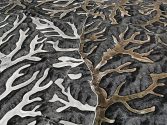
Water covers 70 per cent of the surface of the planet and even when you can’t see it, it’s there – under your feet, as vapour in the air, buoying the 1.4-kilogram heft of your brain as it sloshes inside your skull. So when Torontonians Jennifer Baichwal and Edward Burtynsky decided four years ago to make a feature-length documentary on something as immense and various as water, they knew they would be climbing a slippery slope. Or, as Baichwal put it in a recent interview, “testing how far can you take an idea, a multifaceted subject, and explore it without having it fall apart into complete generalities.”

Read More

“Framework: Capturing the world through photography, video and multimedia,” Los Angeles Times

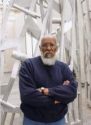
Edward Burtynsky is known as one of Canada’s most respected photographers. His remarkable photographic depictions of global industrial landscapes are included in the collections of over fifty major museums around the world, including the National Gallery of Canada, the Museum of Modern Art and the Guggenheim Museum in New York, the Reina Sofia Museum, Madrid, and the Los Angeles County Museum of Art in California.

Read More

“Lesley Dill’s words-inspired multimedia works to be on exhibition at LSU MOA through January,” The Times-Picayune

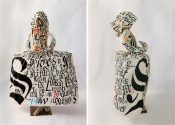
Taming and culling artistic inspiration can often be a difficult task, but multimedia artist Lesley Dill uses a calm, organic approach toward her work. “I think of (ideas) as almost like frogs — jump-up solutions,” explains Dill from her New York studio. “You’re thinking about what to do next, then up from inside your stomach jumps an idea or a material or a medium.” A collection of the results from those ideas will be on exhibition in Baton Rouge from Sept. 6 through Jan. 19 at the LSU Museum of Art. The exhibit, titled “I Gave My Whole Life to Words,” honors Dill’s lifelong love of the written word and her tactile physical representations of her own interpretations.

Read More

“Tribute to late sculptor John Scott is concert highlight,” The Advocate

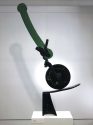
Scott’s large-scale sculpture graces many public places in New Orleans. His “Spiritgate,” for instance, stands at the entrance of the New Orleans Museum of Art. In 2005, the museum mounted a career retrospective of Scott’s work, art that reflects the city’s African-American, Caribbean and Creole heritage. “John Scott is a really big name here,” said Ko, Faubourg Quartet member and chair of NOCCA’s classical instrument department. “His sculpture is everywhere. And the artists we’re presenting in ‘The Art of Music,’ they were all influenced by John Scott.”

Like Ko, Scott saw the connection between various arts disciplines.

“He always talked about the relationship between music and art,” she said. “He believed art and music are not two different genres, but actually one thing. We are using our notes and they are using their pictures to make art.”

Read More

“Roy Lichtenstein sculpture may replace Lin Emery sculpture at NOMA,” The Times-Picayune

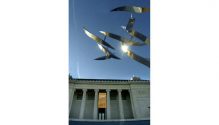
The glinting silver sculpture by Crescent City artist Lin Emery that has stood in the reflecting pool in front of the New Orleans Museum of Art for years has been removed to make room for something new. Word among the city’s art scene insiders is that a newly acquired sculpture by pop master Roy Lichtenstein is slated for the premier spot.

In an email statement, NOMA director Susan Taylor acknowledged that the museum hopes to install “another major work by another major artist by the beginning of 2014,” but she did not confirm the identity of the sculptor.”

“The Lin Emery sculpture was recently removed from the pool in front of the museum in order to commence renovation and repair of the pool,” Taylor wrote. “We are delighted to be able to move her work into the Besthoff Sculpture Garden where, after conservation, it will be placed along the lagoon in visual proximity to the George Rickey and Kenneth Snelson sculptures – a fitting and permanent context for her work. Lin will also be honored at Love in the Garden on September 27 and, later in the fall, with an exhibition celebrating her work.”

Read More

“Carnival Craft,” NOLA Defender

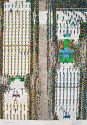
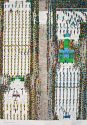
Bruce Davenport’s meticulously plotted Bruce Jr. Does the Parades involves ten gloriously large diagrams of revelers and marching bands from an aerial perspective, and seven specifically hung 11×14 details of Mardi Gras. Each framed paper piece is a crisp 60×40 and they are hung in regimented order, like their subjects are arranged in marching band formation. Davenport worked in marker and pen, but the resulting work feels like a reliquary document instead of a teenage notebook. Davenport takes the viewer through the stories of black New Orleanians by narrating the scenes in ballpoint pen.

Read More

“The 6 shows not to miss at White Linen Night 2013,” The Times-Picayune

Bruce Davenport Jr. has taken his passion for New Orleans high school and college marching bands and translated it into a multi-layered personal language. Stand 10 feet from one of Davenport’s drawings and you will be struck by the artists’ command of stark geometric composition. Stand five feet from his drawings and you will be fascinated by his amazingly complicated hieroglyphic interpretation of Crescent City parades. Lean in for a close look and you’ll be able to read his personal and political musings, delivered with rap swagger. The whole effect is fascinating.

Read More

“The Truisms of Robert Colescott by Lizzetta LeFalle-Collins,” NYU Black Renaissance Noir

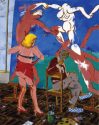
In The Legacy of the Black Arts Movement, author Trey Ellis suggests that the New Breed of Black artists, writers and critics advanced a broad range of aesthetic positions that pointed to an awareness and acceptance of their “cultural mulatto” status and recognized their immersion in and indebtedness to “a multi-racial mix of cultures.”[2] The New Breed Artists regularly employed popular culture as both a playground and a tool of empowerment, using highbrow and lowbrow references that were easily interpreted by all sectors of Black society. Ellis was particularly interested in the tensions these artists experienced between their competing desires to adhere to European and American aesthetic norms and to present an alternative view of Americans whose heritage included a history of enslavement and miscegenation. This double consciousness often invited a collision between content and style, but sometimes, as in the work of Robert Colescott, this twin consciousness became inextricably intertwined as it informed form and materiality.

Read More

“Field Hands,” The Urban Glass Art Quarterly

Thirty miles east of Minneapolis, across the upper Mississippi River that defines the Minnesota-Wisconsin state border, the campus of the University of Wisconsin at River Falls sprawls over more than 400 acres and includes two laboratory farms. The reason for the large agricultural education program becomes clear if you continue eastward, where very quickly you are engulfed in large tracts of farmland. It was here in Midwest farm country, in 1965, that sculptor Doug Johnson, fresh from his graduate studies with Harvey Littleton at University of Wisconsin at Madison, was hired to start a glass program within the well-regarded art department, which draws equally from the Twin Cities of Minneapolis and St. Paul and the farming communities of rural Wisconsin.

Read More