“Backstage at Versailles: A Handyman’s Tour of the Palace,” Messynessy Chic
Robert Polidori has the keys to the palace. But not the perfectly-polished, museum-ready palace we’re used to seeing from behind the velvet ropes.
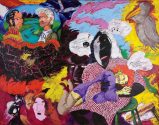
The Vieux Carre’s figurative freak flag dropped to half-staff last week when news circulated that one of the district’s last remaining embodiments of local color had faded to black. George Dureau, one of the city’s most nationally recognized artist and a major player in the local arts scene from the 1970s through the ’90s, was dead at 83, having succumbed to Alzheimer’s disease.
NEW ORLEANS — When news of George Dureau’s death was announced by his gallery this past Monday afternoon, word traveled quickly among my extended circle of friends and professional acquaintances in New Orleans. Within a few hours, my Facebook feed was full of images of Dureau’s work, personal reminiscences, and links to quickly sketched obituaries (the longer tributes would come later) in the New Orleans Advocate and Times-Picayune.
The artist and photographer’s work ranged from the erotic to the unsettling. He was a mentor of Mapplethorpe and a long-time contributor to Drummer magazine. Long-time icon of the creative world of New Orleans, George Dureau died Monday (April 7) morning at the Walden Healthcare Center in Kenner according to NOLA.com. He was 84.
George Dureau, the painter and photographer who captured French Quarter denizens for decades using camera and brush, died today around noon, according to Arthur Roger, the art gallery owner who was Dureau’s longtime friend. Dureau was 82 and had been in poor health. “It’s been a long journey. It’s been a remarkably peaceful one. He was very restful,” Roger told Gambit this afternoon.
Artist George Dureau, master of mythic painting and hyper-realistic photography died Monday morning (April 7) at the Waldon Health Care Center in Kenner, where he was being treated for advanced Alzheimer’s disease. He was 83.
Over at Arthur Roger Gallery, the red pastel figure drawings and glass sculptures of New Mexico-based James Drake’s “Can We Know the Sound of Forgiveness” and the multidimensional poured paintings of Holton Rower ‘s “Viscous Resin Extruding From the Trunk” evoke styles of the past.
“Dreams from the bristles of the artist’s brush… I probe be yond the confines of the finite to create an infinity…Living dreams.” Arshile Gorky’s words, in 1942, at the start of his late, most eloquent, phase. The quote occurred to me during my initial visit to Edward Whiteman’s new exhibition of abstract pictographs (recently at Arthur Roger); it returned during my second.
Jammin’ on Julia, the annual spring street party in the New Orleans Arts District takes place from 6 to 9 p.m. Saturday (April 5). Look for a dozen exhibitions of regional and national artworks augmented by live music in many galleries along Julia Street and nearby. As always, the wide selection of art will hold something to satisfy most taste.
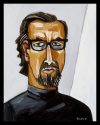
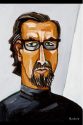
Bunny Matthews new show “The People of New Orleans from A to Z” hangs at the Arthur Roger Gallery throughout March until April 19th, celebrating a closing reception on Saturday the 5th. The series reads like a children’s A to Z book of illustrations on uniformly 17×14 paper, ink, and colored pencil renderings. It is exciting to see cartoon caricatures on the walls at Arthur Roger. The surge of acceptance for comic-style drawing is a late 20th, early 21st century advent, owing nearly everything to New Orleanian George Herriman. Herriman’s “Krazy Kat” strip would be an inspiration to Robert Crumb and eventually Abstract Expressionist Philip Guston. Beginning with the lampooning caricature of Honore Daumier, Daumier’s caricatures have only entered into fine arts education post-feminism.