Gallery News

“Lesley Dill’s words-inspired multimedia works to be on exhibition at LSU MOA through January,” The Times-Picayune

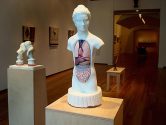
Taming and culling artistic inspiration can often be a difficult task, but multimedia artist Lesley Dill uses a calm, organic approach toward her work. “I think of (ideas) as almost like frogs — jump-up solutions,” explains Dill from her New York studio. “You’re thinking about what to do next, then up from inside your stomach jumps an idea or a material or a medium.” A collection of the results from those ideas will be on exhibition in Baton Rouge from Sept. 6 through Jan. 19 at the LSU Museum of Art. The exhibit, titled “I Gave My Whole Life to Words,” honors Dill’s lifelong love of the written word and her tactile physical representations of her own interpretations.

Read More

“Carnival Craft,” NOLA Defender

Bruce Davenport’s meticulously plotted Bruce Jr. Does the Parades involves ten gloriously large diagrams of revelers and marching bands from an aerial perspective, and seven specifically hung 11×14 details of Mardi Gras. Each framed paper piece is a crisp 60×40 and they are hung in regimented order, like their subjects are arranged in marching band formation. Davenport worked in marker and pen, but the resulting work feels like a reliquary document instead of a teenage notebook. Davenport takes the viewer through the stories of black New Orleanians by narrating the scenes in ballpoint pen.

Read More

“The 6 shows not to miss at White Linen Night 2013,” The Times-Picayune

Bruce Davenport Jr. has taken his passion for New Orleans high school and college marching bands and translated it into a multi-layered personal language. Stand 10 feet from one of Davenport’s drawings and you will be struck by the artists’ command of stark geometric composition. Stand five feet from his drawings and you will be fascinated by his amazingly complicated hieroglyphic interpretation of Crescent City parades. Lean in for a close look and you’ll be able to read his personal and political musings, delivered with rap swagger. The whole effect is fascinating.

Read More

“Review: Works by Willie Birch and Eudora Welty,” Gambit

In the 70-year journey that has taken him from the New Orleans housing project where he grew up to having his work exhibited in some of the more hallowed halls of the New York art world and back to New Orleans again, Willie Birch has always been outspoken. Even so, his current Arthur Roger Gallery show can seem very quiet. Unlike his earlier 7th Ward street scenes, there are no second lines, stoop sitters or funerals in these big black-and-white works on paper, only stark, empty vistas where ragged buildings and rickety fences initially suggest a social realist view of his hardscrabble neighborhood. But like a back street Pompeii, these scarred, unpopulated vistas have their own tales to tell, and if they lack local charm in the usual sense, they are not without dignity. Rendered with eloquent simplicity, they reveal through their subtle luminosity a resonant depth of presence. “It is what it is,” they seem to say, but like the area’s residents, there is clearly more to them than what is seen on the surface.

Read More

“Auction set to benefit iconic New Orleans artist George Dureau,” Times-Picayune

Friends of New Orleans artist George Dureau have organized a benefit auction to help defray costs of nursing and medical care for the 82-year-old French Quarter icon. Dureau, who suffers from Alzheimer’s disease, is confined to a nursing home. Dureau’s personal effects will go on the block at Crescent City Auction Gallery, 1330 St. Charles Ave. The July 13 auction begins at 1 p.m. and features both the studio props that appeared in Dureau’s acclaimed photographs, and a host of domestic objects. Highlights include a 19th century walnut bed; a pair of modernist chairs by Bertoia, and a cypress refectory table that Dureau, a grand entertainer, once used for dinner parties.

Read More

“Oil on Canvas,” The Advocate

When the Macondo well blew in April of 2010, killing 11 men and setting off the worst oil discharge in U.S. history, Jacqueline Bishop’s initial reaction was one of action. After all, the New Orleans-based visual artist has spent decades highlighting environmental issues in exotic locals like the Amazon. Yet here was a major man-made disaster in her own backyard. Bishop spent many weeks during the spill working at Grand Isle State Park cleaning oil from beach-hugging hermit crabs and reintroducing them to the water. It was something to do at a time when those in charge searched, seemingly in vain, for ways to stop the torrent of oil flowing from the Gulf floor.

Read More

“Tattings & Tessellations,” New Orleans Art Review

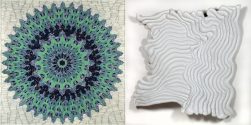
The shape of Relics, presenting new work by artist Troy Dugas, provides a fascinating, intriguing, and interesting experience for viewers familiar and new to the artist’s work. Those for whom the artist’s work is new will have the delightful experience of exploring their way through the intricately patterned iterations of these amazing tessellations for the first time. Those in the know, already familiar with the artist’s earlier work, will have the satisfaction of the insider witnessing the evolution of earlier themes into new variations of recursive patterns. Of interest to both will be the artist’s radical essays into the new subjects of portraits and still lives with their historical and representational references and new ways of working with materials. New expressions of the intricately patterned mandala idea focuses one’s attention away from peripheral distractions and into the minutiae of their making, into meditation on visual pattern and movement as the eye becomes involved in deciphering the complex interrelationships among patterns, rhythms, and repetitions.

Read More

“Dureau,” New Orleans Art Review

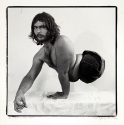
You enter the George Dureau exhibition expecting the celebrated interpreter of the human form, an artist who in his paintings, drawings and photography transforms the figure, even when physically compromised, into a thing of exalted beauty. You leave with that impression confirmed, but with another: an impression of timeless technical ingenuity that transcends mere talent, and, more important, a genuinely moving density of meaning.

Read More

“Inspired by Nature, Tweaked With Satire,” New York Times

On a sunny afternoon last month, John Alexander sat in his studio in Amagansett, surveying a boatload of motley figures on a large painting in progress he had titled “Lost Souls.” It was not a group you would want to encounter on your next cruise. The passengers of this open vessel — some of them wearing strange, beaked masks — included a fellow in a kind of dunce cap; several monkeys, who appeared terrified or glum; and a man with a dyspeptic expression who was — it merited a double take — urinating overboard. “It’s always a similar cast of characters,” Mr. Alexander said of the figures, which have appeared, in various guises, in some of his other satirical works. These tend to include “anybody I perceive as dishonest, hypocritical or just generally up to no good,” he said.

Read More