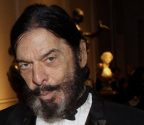
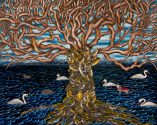
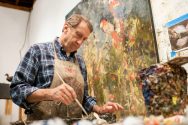
Interview with artist Kate Blacklock
Interview with artist Kate Blacklock, exhibiting at Arthur Roger Gallery in December 2013.
Arthur Roger Gallery is very pleased to be a part of Art Miami this year. At Booth C1, we are exhibiting works by Luis Cruz Azaceta, Richard Baker, David Bates, Jacqueline Bishop, Douglas Bourgeois, Stephen Paul Day, Lesley Dill, James Drake, Troy Dugas, George Dureau, Courtney Egan, Lin Emery, Deborah Luster, Francis X. Pavy, Holton Rower and John Waters. The exhibition will be on view from December 3 – December 8, 2013 at the Miami Art Pavilion located in the Miami Midtown Arts District.
In south Louisiana, we know a thing or two about water. Not only are we surrounded by it, the air we breathe is often permeated with it, so our relationship with water is intimate. But intimate relationships often have elements of surprise, and while Edward Burtynsky’s photographs, which occupy two floors of gallery space at the Contemporary Arts Center (CAC), are often too spectacular to be truly intimate, they do pack a tsunami of surprises. His sweeping amphibious landscapes, whether all natural or shaped by human intervention, can be startlingly abstract, and if the proliferation of large-scale photographs in recent years has already shown us how painterly such images can be, many of Burtynsky’s works bear a striking resemblance to abstract canvases.
“Roll With It: Brass Bands in the Streets of New Orleans” by Matt Sakakeeny with artwork by Willie Birch. Special offer from Duke University Press: Save 30%.
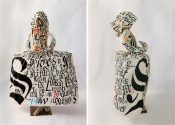
Acclaimed New York artist Lesley Dill will present a lecture entitled “We Are Animals of Language” as part of the LSU College of Art + Design Paula G. Manship Endowed Lecture Series. Lesley Dill is one of a series of visiting artists participating in LSU School of Art’s 2013–14: Malleable Language exhibition season, whose theme is the visual and critical exploration of the artistic tradition of intermingling text and image. Her works in sculpture, photography, and performance use a variety of media and techniques to explore themes of language, the body, and transformational experience. Dill has called herself a “matchmaker of words and images,” and she often pulls from the poems of Emily Dickinson and other poets and writers to create sculptural costumes, mannequins, and floor-to-ceiling backdrops covered in interweaving black text and images.
Lin Emery (Hudson Hills Press, 2012) is, at one level, the coffee table book which every artist covets as the pinnacle of his or her career. The young artist-in-training will drool over its glossy dust-jacket, its gray cloth covers with “Lin Emery” embossed upon the front in silver (this in anticipation of generations of library shelf wear), its russet end papers, and its one-hundred and twenty-two color plates.
When New Orleans Museum of Art guests celebrate the 10th anniversary of the Sydney and Walda Besthoff Sculpture Garden Friday night, Lin Emery’s work, “Wave,” will be on proud display in its new setting. The kinetic work by the nationally recognized New Orleans sculptor became an instant icon when it was installed in a reflecting basin in front of the museum in time for the 1988 Republican National Convention. Recently, the need to rebuild the 100-year-old basin meant moving the sculpture requiring museum staff to work with Emery to determine the perfect site for it.
Throughout his career, photographer Edward Burtynsky has been on a quest to capture the impact humans have on the natural landscape. “Nature transformed through industry” is how he puts it. Burtynsky has photographed e-waste recycling facilities in China, nickel tailings in Ontario, railways cutting through the forests of British Columbia, quarries in Vermont and mines in Australia. He has also turned his lens to suburban sprawl, highways, tire piles, oil fields and refineries.
Water covers 70 per cent of the surface of the planet and even when you can’t see it, it’s there – under your feet, as vapour in the air, buoying the 1.4-kilogram heft of your brain as it sloshes inside your skull. So when Torontonians Jennifer Baichwal and Edward Burtynsky decided four years ago to make a feature-length documentary on something as immense and various as water, they knew they would be climbing a slippery slope. Or, as Baichwal put it in a recent interview, “testing how far can you take an idea, a multifaceted subject, and explore it without having it fall apart into complete generalities.”
Edward Burtynsky is known as one of Canada’s most respected photographers. His remarkable photographic depictions of global industrial landscapes are included in the collections of over fifty major museums around the world, including the National Gallery of Canada, the Museum of Modern Art and the Guggenheim Museum in New York, the Reina Sofia Museum, Madrid, and the Los Angeles County Museum of Art in California.