“Luster Captures Portraits of Inmates”, 2theadvocate.com
Time is frozen behind the gate, even as one slide follows another on the screen.
There’s Gumby and Cornbread. No, that’s not Cornbread; his nickname is Padu. He lives in the Main Prison now.

Time is frozen behind the gate, even as one slide follows another on the screen.
There’s Gumby and Cornbread. No, that’s not Cornbread; his nickname is Padu. He lives in the Main Prison now.
Deborah Luster: One Big Self by The Kitchen Sisters, npr “My mom… It’s hard to talk about your mom. She was very glamorous but she never put on any airs….
November 1988 Exhibition at Arthur Roger Gallery
November 1988 Exhibition at Arthur Roger Gallery
I can’t really say that there’s a unifying theme,” says New Orleans-born sculptor Ersy about the works in her first exhibit in more than six years, now at the Arthur Roger Gallery.
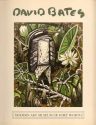
These works by American artist and painter David Bates show his affinity with the people and surroundings of the Arkansas and East Texas region.
1988 Interview with David Bates – presented by the Modern Art Museum of Fort Worth and produced by KXAS-TV, Channel 5.
For an artist, no event is more significant than a retrospective exhibition. As the word implies, a retrospective provides an occasion for looking back, for identifying themes, both stylistic and pictorial, that characterize a body of work. Usually, a retrospective inevitably entails reflection and reassessment. While everyone has such moments in life – a major anniversary or a birthday marking a decade – an artist is confronted with a tangible record that must be faced with prevarication or self-delusion. For an artist to “dry up” in his/her primary medium after a retrospective is not at all unusual. Often a painter or sculptor will work only in drawings or prints for a few weeks or months on the heels of this hiatus. For an artist to make a radical and prolonged change, not only in style but in medium as well, however, is indeed unusual. But that is exactly what Robert Gordy did after his 1981 retrospective at the New Orleans Museum of Art.
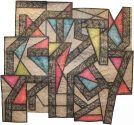
Few people confronting Edward Whiteman’s “reconstructed” paper-and-canvas sculptures for the first time would suspect that they were inspired by New Orleans.
The stony-looking relief pieces are irregularly contoured collages, combining torn sheets of creased and stained paper with fragments of rumpled canvas, also stained and in addition painted with bold hieroglyphic markings, usually in red. What connections could these venerable even archeological-locking sculptures possibly have with New Orleans?
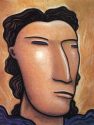
In the summer of 1982 painter Robert Gordy abandoned his arch, patternizing, Art Deco-inflected signature style. Since that time he has devoted most of his energies to making monotypes, and the principal focus of his attention has been the human head. Gordy’s second gallery showing of his new work was a knockout, some two dozen suave yet honest works without a ringer in the lot. The monotype medium has provided Gordy with a form of no-risk, gestural spontaneity, and a genuine “painterliness” emerges in the trailed lines and heavily worked or mottled areas, even as the luminous etching ink and insistent gleam of white paper preserve the essential flatness which has always been fundamental to Gordy’s art.