
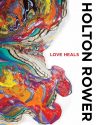
“A Range of Motion,” NOLA Defender
The New Orleans-based kinetic sculptor conjures up the mechanized hum of another world through her theatrical plug-in pieces at the Ogden Museum of Southern Art in an exhibition that includes everything from roving robots to the clang and thump of motorized music. While these installations are certainly electric, they’re decidedly different than Emery’s wind and water-driven creations that might be more familiar to the city’s residents.
“Willie Birch’s Art Brings Shades of Light to the Crescent City,” New Orleans Living
Birch moved back to the Crescent City in the early 90s after receiving a Guggenheim grant to produce a body of work based on growing up in New Orleans. He bought and gutted a property on N. Villere Street, which eventually became his studio space. The old stomping grounds of Mardi Gras Indian Chief Tootie Montana and jazz legend “Jelly Roll” Morton, Birch couldn’t have felt more at home. He began compiling life-sized color portraits of African Americans, but his work has since evolved into black and white through use of acrylic and charcoal on canvas.
“Robert Gordy,” The Archive
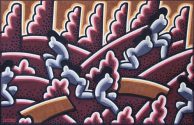
Gordy was born into a fairly well-off Louisiana family. His father took over a family business in New Iberia—salt mining—when Gordy was seven and the family moved to this seeming isolation. Gordy was already dreaming of becoming an artist at this early age, and New Iberia was to deliver a lucky stroke for Gordy when he was taken under the wing of Weeks Hall, a New Iberia resident who had studied at the Pennsylvania Academy and in Paris. Hall educated Gordy about the world of art. By age 15, Gordy was winning awards for his art in Louisiana, and a Scholastic Gold Key at 18. He received a BFA and MFA from Louisiana State University.
“The Hateful Years: Mark Flood Takes On Luxembourg & Dayan,” Huffington Post

Mark Flood is often referred to as a punk artist, partially because he played in a band named ‘Culturcide’ in his youth, and also because he makes some very angry paintings. At 54, the Houston-based artist is looking back on his oeuvre in a new solo show. Though we’re not often fans of ’80s nostalgia, we are happy to report that the first survey of Flood’s work during this period is now on view at Luxembourg & Dayan in New York, and it’s worth checking out.
“Art: Francis X. Pavy – At last, a tribute to the statehood bicentennial,” Louisiana Life Magazine
Francis Xavier Pavy, long known for his vibrant and whimsical paintings of Louisiana’s Cajun and zydeco music, is telling the story of the state’s history the best way he knows how – through his art. In his new work, 200: Art Inspired by 200 Years of Louisiana Statehood, he has created an ambitious series of paintings that explores the history of Louisiana from colonial times to the present. This tribute to Louisiana, however, is not a chronological narrative of the state’s 200-year history but paintings filled with symbols representing events, people and aspects of Louisiana’s past and present.
“Just (a few more) Kids: George Dureau, Robert Mapplethorpe and Company,” Jeu de Paume
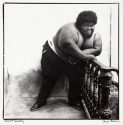
Dureau, on the other hand, was a people person, not an aesthete like either Mapplethorpe or Weston. His pictures breathe, they pulse, they are hot with the blood and sweat of the sitters who joined him in his apartment on Esplanade Street in the city where he was born, and sometimes posed with props that were part of his personal effects. Edward Lucie-Smith, who wrote a fine introduction to a book of Dureau’s photographs published in the 1980s, compared the artist’s ability to transform these autobiographical encounters into photographically classical pictures with the writing strategies of Baudelaire, most notably in the Tableaux Parisiens of Les Fleurs du Mal.
“Artist Mark Flood makes a rare appearance at…his own exhibition,” CAPITAL NY
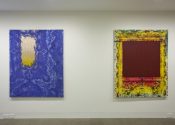
Flood’s most recent works are his “lace paintings,” which he’s been at for more than a decade now. Originally conceived as backdrops for his text incitements, the lace paintings took on their own life. Painted in acrylic on canvas, the images are created by using tattered lace pieces—sourced from thrift and fabric shops—as stencils. They are dipped in paint, then spread on the canvas, then painted over, then removed (the timing for removal is evidently key). They are intricate, delicate, technically innovative, and abuzz with color: wholly unlike anything else he’s done. They have certainly become highly sought-after and are largely responsible for the invigoration of his career.
“There’s Something About Mark Flood: Cameron Diaz Turns Up for ‘Hateful Years’,” GalleristNY

Barry Manilow and David Lee Roth—present in the form of grotesquely distorted photo collages—weren’t the only celebrities at the opening of artist Mark Flood’s career survey, “The Hateful Years,” at Upper East Side gallery Luxembourg & Dayan the other night. Cameron Diaz was on hand, and paused to pose for photographer Mary Barone (remember her people pics from the sadly now-defunct Artnet magazine?) along with Mr. Flood and the artist Dan Colen.
Altogether Elsewhere – Three Projects by John Pilson
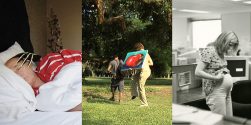
The Arthur Roger Gallery is pleased to present “Altogether Elsewhere – Three Projects by John Pilson.” The exhibition will be on view in the Arthur Roger Gallery video exhibition space, located at 432 Julia Street, from August 4 – September 15, 2012. The gallery will host an opening reception with the artist in attendance, Saturday, August 4 from 6-9 pm in conjunction with “White Linen Night.”