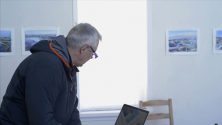
John Hartman at work in the Crowsnest Pass

John Hartman paints a watercolour study of the Industrial Canal in New Orleans (included in his 2013 exhibition at Arthur Roger Gallery) during his residency at the Gushul Studio in Alberta’s Crowsnest Pass.

Read More

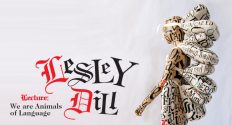
“Lecture and Exhibition by New York Artist Lesley Dill,” LSU College of Art + Design

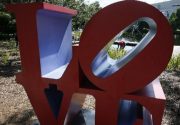
Acclaimed New York artist Lesley Dill will present a lecture entitled “We Are Animals of Language” as part of the LSU College of Art + Design Paula G. Manship Endowed Lecture Series. Lesley Dill is one of a series of visiting artists participating in LSU School of Art’s 2013–14: Malleable Language exhibition season, whose theme is the visual and critical exploration of the artistic tradition of intermingling text and image. Her works in sculpture, photography, and performance use a variety of media and techniques to explore themes of language, the body, and transformational experience. Dill has called herself a “matchmaker of words and images,” and she often pulls from the poems of Emily Dickinson and other poets and writers to create sculptural costumes, mannequins, and floor-to-ceiling backdrops covered in interweaving black text and images.

Read More

Edward Burtysky: Water

Exhibition Dates: October 5 – November 23, 2013 Opening Reception: Saturday, October 5 from 6–9 pm (in conjunction with “Art for Arts’ Sake”) Gallery Location: 432 Julia Street, New Orleans, LA… 

Read More

John Hartman: New Orleans From Above

Exhibition Dates: October 5 – November 23, 2013 Opening Reception: Saturday, October 5 from 6–9 pm (in conjunction with “Art for Arts’ Sake”) Gallery Location: 434 Julia Street, New Orleans, LA… 

Read More

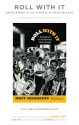
“Lin Emery by Philip Palmedo: A review by G.W. Smith”

Lin Emery (Hudson Hills Press, 2012) is, at one level, the coffee table book which every artist covets as the pinnacle of his or her career. The young artist-in-training will drool over its glossy dust-jacket, its gray cloth covers with “Lin Emery” embossed upon the front in silver (this in anticipation of generations of library shelf wear), its russet end papers, and its one-hundred and twenty-two color plates.

Read More

“Familiar artwork installed in sculpture garden, just in time for gala,” The Advocate

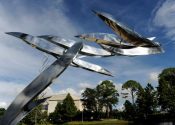
When New Orleans Museum of Art guests celebrate the 10th anniversary of the Sydney and Walda Besthoff Sculpture Garden Friday night, Lin Emery’s work, “Wave,” will be on proud display in its new setting. The kinetic work by the nationally recognized New Orleans sculptor became an instant icon when it was installed in a reflecting basin in front of the museum in time for the 1988 Republican National Convention. Recently, the need to rebuild the 100-year-old basin meant moving the sculpture requiring museum staff to work with Emery to determine the perfect site for it.

Read More

“Aerial Views of Our Water World,” Smithsonian Magazine

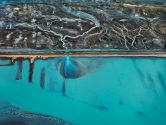
Throughout his career, photographer Edward Burtynsky has been on a quest to capture the impact humans have on the natural landscape. “Nature transformed through industry” is how he puts it. Burtynsky has photographed e-waste recycling facilities in China, nickel tailings in Ontario, railways cutting through the forests of British Columbia, quarries in Vermont and mines in Australia. He has also turned his lens to suburban sprawl, highways, tire piles, oil fields and refineries.

Read More

“Apocalypse Now: Jacqueline Bishop,” Pelican Bomb

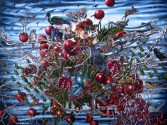
[Jacqueline] Bishop’s long career in working at the intersection of environmentalism and visual art includes not just Louisiana and the Gulf Coast, which inspires much of her work, but a longstanding relationship with Central and South America and the rainforest conservation work of the late Brazilian rubber-tapper Chico Mendes. Close to home, Bishop’s imagery has always focused on native flora and fauna, painting them with a mixture of close, attentive realism and wild, exuberant surrealism, not unlike a latter-day Hieronymus Bosch. And similar to The Garden of Earthly Delights, in much of Bishop’s work, looking at her paintings is like reading a sentence in which we recognize the words but don’t understand the grammar.

Read More