“Gene Koss’s New Work,” New Orleans Art Review
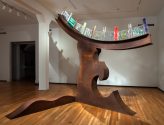
LIKEABLE. GENE KOSS’S work is likeable. And I like looking at his work. Seeing how earlier themes continue to evolve, what new variations on the theme of, for example, Disc Drawings, have been developed, what new huge piece has taken form, and what new ideas have been added too the artist’s repertoire, as some idea are revisited and renewed, while others are new. This new exhibition at the Arthur Roger Gallery is no exception. Especially interesting is to see the new large work that the artist has conceived, Line Fence in this exhibit. Working with cast glass as his primary medium, which he often combines with various and sundry other materials and found objects, Koss’s work challenges whatever reservations one may have, with respect to a medium conventionally associated with utilitarian objects, about the viability of glass as a material for conceptual art. Combine Koss’s wit, expressed in titles evoking amusing associations that offer multiple paths for approaching the work, with the artist’s use of glass in ways unexpected by those unacquainted with its potential, and the confident craftsmanship of the mature artist produces work that represents a confluence of formal strength, humorous associations, and syntheses of multiple historical antecedents.
Read More

James Drake: Can We Know the Sound of Forgiveness

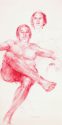
Can We Know the Sound of Forgiveness, James Drake’s eleventh exhibition with the gallery, features a collection of the artist’s “red” drawings as well as a grouping of glass sculpture. The pastel drawings continue to reveal the renowned artist’s method and deliberation. The subjects, always personal, are often flecked with faint notations and markings, on paper consumed by the process, sometimes pieced together with exposed tape.

Read More

Holton Rower: Viscous Resin Extruding From The Trunk

This second exhibition with New York-based artist Holton Rower includes his remarkable “Pour Paintings” along with a unique body of work titled “Focus paintings.” Holton Rower, who has been referred to as a “chemist and sculptor of paint,” is renowned for the incredible color combinations he achieves which can be stunningly psychedelic and hypnotic.

Read More

“Reflections on Water,” New Orleans Art Review

FIRST IMPRESSIONS: IMMACULATE surfaces, varied lines and shapes, contrasts and harmonies of color, rhythms and textures evoking an elusive sense of the familiar, of mystery, wonder, and delight in the interplay between precision and ambiguity, abstract patterns, designs, and suggestions of the representational with the possibility of evolving into the beautiful, the sublime, and the merely interesting that, as photography, challenges Benjamin’s lament of the destruction of aura ‘in the age of mechanical reproduction’. At first the exhibit seems a visual extravaganza without any apparent unifying theme, a polysemous conflation of works by different artists, even though the title clearly states that these are photographs from Edward Burtynsky’s Water Series. Slowly one focuses on individual photographs, responding to each on its own terms, and only then developing some understanding of visual and conceptual interrelationships within and among through shared associations and significant differences as the overwhelming initial reaction (if they were not contained within the solid black frames they might fly away) evolves into a sense of coherence.

Read More

“Strokes of Genius: Review of Kate Blacklock’s Still Life Nightscapes,” NOLA Defender

When you find out that Kate Blacklock uses a scanner for a camera, you react in one of two ways: “Everything is a miracle” or “Nothing is a miracle.” Either you dismiss her photos as an unorthodox divergence from the strict definition of the medium, or you are intrigued by what she might be able to do with a flatbed, office-type scanner. You may look at her subject matter and decide that her “Still Life” or “Nightscape” work is unremarkable, but this would be overlooking many aspects of the work, most of all the strange and wonderful process of how she makes it. It was Albert Einstein who proposed that there are basically just the two ways to live life. We must assume that the German Jewish scientist whose name has become synonymous with the word “genius” lived like everything was a miracle – he was himself kind of a miracle.

Read More

“Aljira presents major survey exhibition by Cuban-American artist, Luis Cruz Azaceta,” News International

Luis Cruz Azaceta: Dictators, Terrorism, War and Exiles explores the human impact of war and isolation. Newark, New Jersey—Aljira, a Center for Contemporary Art is pleased to present Bending the Grid. Luis Cruz Azaceta: Dictators, Terrorism, War and Exiles, a major survey exhibition of paintings by a leading Cuban-American artist which explore the possibilities of formal experimentation with political and social issues. Redefining Expressionist painting into a humanist narrative, Cruz Azaceta bears witness to the impact of war and isolation. An opening reception, gallery walk and catalog signing will take place on January 23, 2014 from 6 to 9pm with the artist and curator Alejandro Anreus, PhD., Professor of Art and Latin American Studies, William Patterson University, NJ. Luis Cruz Azaceta was born in Havana, Cuba. As a teenager, he witnessed many acts of violence on the streets of Havana which created within him a sensitivity towards violence, human cruelty, injustice and alienation—later these became central themes in his work. At 18 years-old, Cruz Azaceta left Cuba for New Jersey then, New York City. In 1969 he graduated from the School of Visual Arts in Manhattan. Cruz Azaceta’s “apocalyptic pop” style characterized his initial entry into the art world. By the end of the 1970s Cruz Azaceta was working in a highly personal vocabulary that synthesized bold colors and thick outlines. Today he is considered one of the great expressionists, utilizing the artform as a social and moral force.

Read More

“Sunrise: Recent Glass Sculpture,” Glass Quarterly

A surprising number of Midwestern artists have ended up in New Orleans over the years. Some became influential educators in local universities, where their work ethic set a certain tone even as their art often succumbed to the pervasive tropical surreality of their surroundings. Gene Koss, the founder of Tulane University’s glass program, exemplifies that work ethic, but his vision remains firmly rooted in the rural Wisconsin landscape, where he grew up on a family farm. His rural outlook can seem paradoxical from a fine arts perspective. Farming is hard work that requires great physical and emotional endurance, and generations of farm boys have looked to universities and the arts to escape the monotonous toil that defined the lives of their parents. Koss is a rare exception. His vision embraces the heartland ethos of soil, toil and tenacity, in works that can weigh more than eight tons and look as rugged as they are precisely constructed. Yet his single-minded pursuit of his unique vision has paid off, as his influence has only grown over the years. In an age when critical irony has become a default position in the art world, Koss celebrates not only the elemental physicality of the land and the people and machines that work it, but also their mythopoetic resonance.

Read More