Stephen Paul Day’s Blame It On Vegas – Collecting Meta-Modern

Installation images from Stephen Paul Day’s Blame It On Vegas – Collecting Meta-Modern – May 2013 Exhibition at Arthur Roger Gallery.

Installation images from Stephen Paul Day’s Blame It On Vegas – Collecting Meta-Modern – May 2013 Exhibition at Arthur Roger Gallery.
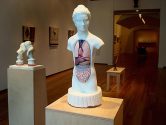
What do the rise and fall of empires have to do with Las Vegas? Probably not much except that both are marked by glamorous and grandiose symbolism. History is a roll of the dice, and somebody always loses. Empires were often fueled by visions of vast wealth, yet they eventually crumbled. Stephen Paul Day’s Blame It On Vegas exhibition actually focuses far more on European history than it does on Nevada’s Sin City, which is mostly represented here by his oversized paintings of tacky souvenir matchbooks. By contrast, his sculptures often feature mini-renditions of major figures in European history.
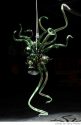
The Lauren Rogers Museum of Art recently acquired the Dale Chihuly Aventurine Green Chandelier with Copper Leaf.

Photos from Robert Gordy: Selections from the Estate of Robert Gordy Benefiting the New Orleans Museum of Art – May 2013 Opening Night

Photos from Stephen Paul Day’s Blame It On Vegas – Collecting Meta-Modern – May 2013 Opening Night

A zebra leg, a copy of Mein Kampf, slave shackles—discrete objects laden with meaning and chosen for their obvious aura—are precisely the kind of curiosities one might find in collections housed at institutions such as The Museum of Jurassic Technology, The Griot Museum of Black History, or the Mütter Museum. Contextualized alongside other anonymously created or found works, some humorous, some horrific, Blame It On Vegas – Collecting Meta Modern functions as a Wunderkammer, a collection that inspires infinite interpretations. The title is both a response to Robert Venturi’s controversial book Learning from Las Vegas and a rejection of postmodernism in favor of a new romanticism or what has come to be known as metamodernism. This slightly nebulous curatorial approach is, in a sense, a “metagesture,” where objects and ideas are abstracted and obscured. Oscillating between modernist vocabularies and postmodern strategies, but relying on neither, there is a rigor and a sense of purpose that unites this collection, though the precise meaning may not be, or may never be, fully realized.

Smart, sure and silky smooth, Gordy’s acrylic canvases from the 1970s and 1980s remain a high water mark in New Orleans art. Gordy was one of those painter’s painter; his every work is a lesson in color choice, value modulation and economical design. After all these years, I imagined I’d seen all of Gordy’s mid-career works, but the shaped canvas waterfall featured on the gallery website was a revelation
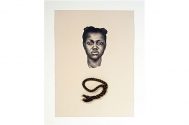
About ten years ago American Legacy featured an artist named Whitfield Lovell in an article titled “Whispers from the Walls.” The Bronx-born Lovell, whose three-dimensional tableaux—life-size charcoal portraits on pine board, punctuated with everyday (and not so everyday) objects found in flea markets and antique malls, tel the life stories of ancestors, family, and once anonymous individuals from the nineteenth and early twentieth centuries.

Stephen Paul Day has chosen to be both creator and curator for Blame It On Vegas – Collecting Meta Modern, his seventh exhibition with the gallery. Sculpture, neon and paintings make up this collection of new, engaging works that oscillate between humor and horror, history and the present and also between the artist’s vocabulary – color, form, and significance of materials – and his viewpoint – how one engages the viewer to make sense of the vision he is presenting. Grouped together as they would be in a museum, there is an intentional ambiguity as to who made each work. Day describes himself as a “Disney kind of collector, putting together a ‘wunderkammer’ of excellent art, artifacts, and story.”

Robert Gordy is considered one of the most original and creative Southern painters of the twentieth century. His unfortunate death from AIDS in 1986 at the age of 52 was an enormous loss. The paintings in this exhibition, on both canvas and paper, date from between 1954 and 1981. Many of the works contain the artist’s clean-edged and stylized forms, melodic patterns and flawless color harmonies so characteristic of his work prior to 1982.